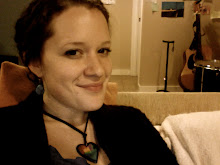
This semester I took an incredible course on women's leadership taught by two of the most amazing and inspriational women I have ever met. It was an intimate class, with about 20 women, and we sat in a circle for 3 hours a week sharing our dreams, fears, beliefs, goals, and visions. Each week we were responsible for writing a journal on a different topic (sometimes there was no topic and we could reflect on whatever we wanted), and one week in particular, we had to write a journal on 3 interviews we conducted over the course of the semester. The assignment was to interview 3 women in our life about what leadership means to them and the role that it has played in their lives. Below is the piece I came up with. I hope you find something noteworthy to take from my experience. With love, encouragment, and gratitude--Rach
“First we are children to our parents, then parents to our children, then parents to our parents, then children to our children,” (Milton Greenblatt). The cycle of learning and caring for one another is an ongoing process full of opportunity to lead, follow, and most importantly known when it's time empower ourselves or pass the baton. Throughout my interviews with three amazing people, all of different generations and with different relationships to me, a certain theme was born as they talked of leadership: self-awareness and inner happiness leading to empowerment and unity with others. Nuerrdina from Off Campus Housing, Lauren, a freshman from New Jersey, and my beautiful mother, a teacher of 32 years and counting, were the three women I thought would make great subjects for these interviews on leadership. It was amazing to hear their views and how they’ve lived, succeeded, and struggled with leadership's ongoing process.
I walked into Nuerrdina’s Off Campus Housing office at 1:55 p.m. for our 2 p.m. meeting. Luckily, because it was an open workspace, I had the special opportunity of observing her before we even started talking. She was helping a student brainstorm ideas for a difficult paper, but not like any old person asking mediocore questions. No, Nuerrdina was impressive with this! She spoke earnestly to the young woman and said, “It’s not about what your opinion is…it’s about how well you can support it and how deeply you are willing to dig to find answers that are real for you. You can’t just provide fluff that sounds good. You have to understand fully why you believe something in order to make a case for it.” Immediately I knew that Nuerrdina exemplified a special aspect of what I view as leadership—a person’s willingness and commitment to questioning individual beliefs in order to develop a strong sense of self.
Later when I asked Nuerrdina what she thought some defining traits of leadership were, she took the notion of developing a strong sense of self to another level. She said, “[leadership is] the practice of self-refinement through community action. We will always be building a self that we and others can rely on…Remember, that it is not really about you and at the same time, has everything to do with you. "Leadership" is about positive social change or liberation, through community action.” Do you hear the Ghandi tone in Nuerrdina's words?—in order to make change through community action, you must have first made change within yourself. ("Be the change you wish to see in the world").
Well, Neurrdina has definitely taken on the challenge of developing a strong sense of self as the foundation for community action. When we first sat down for our interview and I was reintroducing the purpose, I told Neurrdina that I wanted to get a sense of what another woman thought about leadership based off of her own life experiences. This is where I was quickly put in my place and reminded that even something seemingly obveous is not something we can always assume to be true.
“Well first of all I don’t consider myself a woman. I’m gender queer. I’m not a gender, I DO gender.” While I felt slightly embarrassed at my unawareness, I was so glad that Neurrdina had the guts, comfort and confidence to make sure I understood that part of her identity. (Do I use the word “her”?) See, the lines that our society uses to identify people, needs such serious bending (or dismantling all together). But it’s not going to change without individuals changing it. That’s where it takes true leadership in the form of courage, awareness and a sense of self to stand up in declaration for a worthy cause. Some believe that leadership has to mean one person intentionally leading a group of others. But usually, it is the individuals who have figured out how to lead themselves that become true leaders and role models to us all. As a result, they really understand the way to accomplish community action, because they have that solid understanding of the cause, and motivation from the deepest parts of their heart to push until the cause is accomplished.
While interviewing my friend Lauren, a similar idea of what she viewed as leadership came out. I asked Lauren who in her life displays the most leadership and what traits that person possesses. I was expecting her to say someone at the university who is really involved. But she ended up answering her 8th grade science teacher, Kim. Why? It wasn’t because she was doing a lot to lead others intentionally or taking on particular “leadership roles." It was because of her strong sense of individuality. Since 8th grade, Lauren has developed a close friendship with Kim, and she had this to say about her:
“Kim never feels the need to categorize herself or let others define her or what she should be doing with her life.” Lauren went on, “she has the courage to always stand up for what she thinks is right, regardless of whether or not people will follow her. She’ll be the first to stand up if something’s wrong and would love to have people back her up, but doesn’t need them to.”
Similar to the way I see Neurrdina as a leader, Lauren sees Kim as a leader because she has the awareness to lead herself. So many of us, myself included, are constantly working to strike a balance within ourselves that will lead us where we want to be going, rather than just the direction that mainstream society points us in. Perhaps when we master the balance enough so that we can reach beyond ourselves and lead a GROUP in a direction more powerful than mainstream society…perhaps that is reaching a pivotal point in leadership.
But being a leader isn’t easy. Once you’ve become an example of a leader, you constantly have people looking up to you as such, and that creates a lot of responsibility and pressure. Lauren put it well when she said, “as a leader you’re constantly being judged, and if you mess up, the responsibility falls on you. It takes a lot of courage to put yourself in this position.” And I think that really brings us back to the idea of having a strong sense of self, as well as viewing leadership as a constant work in progress. A person is never complete in their position as a leader. There is always room for improvement and struggles that will come up no matter how much experience a person has. That’s why it’s critical for a leader to be confident in who they are, but also flexible and willing to learn. A leader should not be emotionally torn apart by criticism, but they also should not ignore it’s value. To be a good leader you must constantly be working to stay balanced within yourself and among the group you’re working with.
My mother also talked about finding “inner happiness” as a priority in her life, and an essential component to being a truly extraordinary leader. After being a teacher for over 30 years she said, “in ways you have to be a leader for others…You have to learn how to run and organize things, as well as foster a positive group dynamic among your co-workers.” But when it comes to leading herself, my mom, like so many others, is still working on “enjoying life” despite the task of “getting through the daily grind and just doing what you have to do.”
My mom talked about how before she got married she was such a free spirit and adventurer. And then she slipped into grumbling about the “daily grind”—the responsibility and routine lifestyle that occurs when you take on a full time job and marriage. At this point in our conversation I started to feel very worried about ever experiencing the bore of going through the motions, and instantly decided that I would never get married or have a stable job! Just kidding. But in all seriousness, my mom said that there were two things that made the idea of settling down all worth it: a job that was exciting and energizing, and becoming a mother.
My mom has a lot to say when I asked her to define leadership. She said, “Fostering a positive outcome and guiding people, but allowing consensus and listening to opinions… It’s facilitating, a good leader is a good facilitator. The humanistic part of it is also important and a lot of people fail to consider that. You have to be educated in understanding personality types, strengths and weaknesses, and pulling on the strengths. This means giving a lot of positive reinforcement, acknowledging people’s accomplishments, and making sure that they know that you know how valuable they are. And also guiding and helping those who are less experienced or are having difficulties in something.”
When my mom spit out this definition of leadership, I thought to myself, wow...I’m my mother’s daughter! I really saw myself in her definition, and had this childish smirk on my face that read: My mom's a rockstar. I'm going to be just like her when I grow up! So naturally, I asked her what she thought leadership had to do with being a mother, or being in a family. To which she replied, “Everything. Being a mother was one of the strongest forces in teaching me how to be a leader. All of the things I just mentioned you have to learn how to do in a family… Especially listening to each other and working with people’s strengths.”
Before having this conversation with my mother, I usually envisioned leadership as something that most women only have energy for until they get married, start a family, and get into the “daily grind”. People are always saying, “be a leader now because once you get out of college you won’t have nearly as much energy as you do now.” But after talking with my mother about this, I’m realizing that there are so many women leaders everywhere you turn…especially in homes across the world, fostering beautiful families and still managing to contribute to society in such valuable ways—even if it’s “only” through raising children who will be engaged citizens. That is such a difficult, challenging, and important task that takes tremendous heaps of energy and does not receive nearly enough credit or attention. (Thank you to all the incredible mom's, or people raising children out there!)
I initially wanted to ask my mom how she tought women could be more engaged in society and simultaneously raise a family. But after looking back and hearing my mom speak on these topics, I've realized that my mom is satisfied with the way she's lived her life. She really believes that every day of her working life as a teacher she was contributing to society in such a huge way by educating children, and this has been fulfilling, meaningful, and enough.
In writing this, I’m realizing that I have a slightly different view of what it means to be a leader than I did before these interviews. Perhaps being a leader is really striving to fulfill your own life’s purpose. When I asked each person what their biggest priority is in life right now, they all answered something different. But they also all went on to talk about how they’re trying to make their priority a reality. To me, that’s leadership. Each person has a different purpose and reason for being here. But oftentimes, people go through an entire lifetime without ever really finding, acknowledging or fulfilling their purpose. When you ask the average person who they think the greatest leaders are, you get so many different answers. People are different and have such varying views on things. But nevertheless, a leader is someone who proactively attempts to fulfill their own life’s vision. I never realized what an incredible role model and leader my mother is until realizing that she is fulfilling HER purpose. In the end, we all have a purpose worth finding that is truly unique and individual. Therefore, we all have the capability to be leaders, if for no one else, at least ourselves.